




In the global landscape of aesthetic medicine, Seoul has indisputably established itself as the epicenter of facial contouring and rhinoplasty. For international patients considering primary rhinoplasty in Seoul, the decision often stems from a desire for precision, advanced technology, and surgeons who possess an intricate understanding of facial harmony.
At View Plastic Surgery, we understand that undergoing surgery abroad is a significant life decision. This comprehensive medical guide is designed to walk you through every aspect of the process—from the anatomical science behind the procedure to the logistics of medical travel.
Why Choose Seoul for Your First Nose Surgery?
The phrase “Rhinoplasty in Korea” has become synonymous with excellence, but what drives this reputation? It is not merely a trend; it is backed by clinical volume and technological integration.
High-Volume Clinical Expertise
Korean plastic surgeons perform some of the highest volumes of rhinoplasty procedures globally. This high frequency translates into refined dexterity and the ability to handle complex anatomical variations. At View Plastic Surgery, our specialists are not generalists; they are dedicated facial experts who understand the nuances of both Asian and Caucasian nasal structures.
Advanced Diagnostic Technology (3D CT)
The era of “guessing” is over. Modern nose job Seoul protocols mandate the use of 3D CT (Computed Tomography) scanning. This allows surgeons to visualize the nasal septum, turbinates, and bone structure before making a single incision. It ensures that the surgery addresses not just aesthetics, but also functional issues like deviated septums.
The "Golden Ratio" Aesthetic
Unlike Western approaches that often focus on reduction, Korean rhinoplasty often involves a balance of augmentation (bridge) and refinement (tip). The goal is to create a profile that harmonizes with the forehead and chin, adhering to the “Golden Ratio” of facial aesthetics.
To start your assessment, you can utilize our online consultation service to receive a preliminary evaluation.
Understanding Rhinoplasty: Surgical Approaches
Primary rhinoplasty is not a “one-size-fits-all” procedure. The surgical approach is determined by the patient’s anatomy and desired outcome.
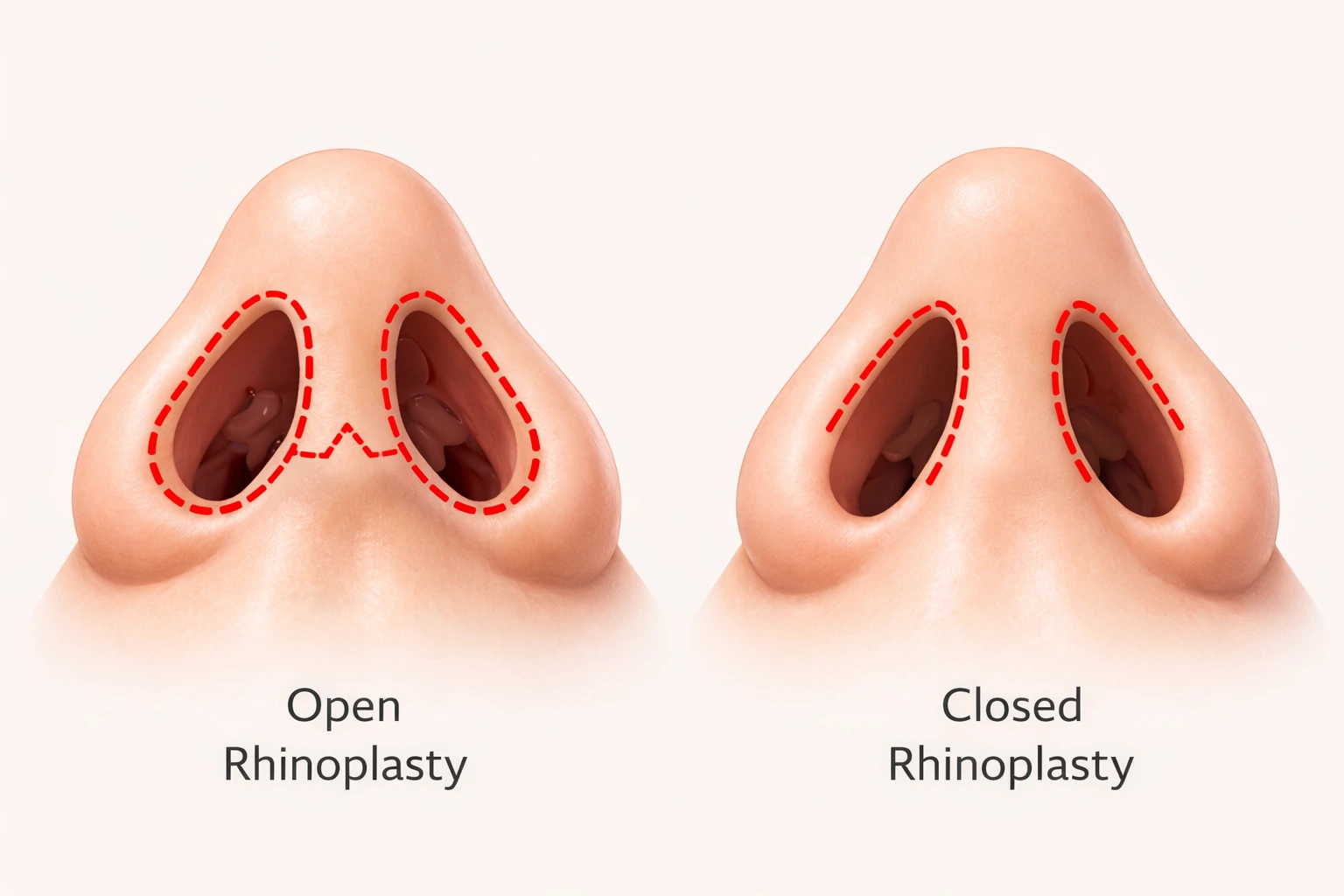
Open Rhinoplasty
Technique: An incision is made across the columella (the tissue strip separating the nostrils), connected to internal incisions. The skin is lifted to fully expose the nasal framework.
- Pros: Provides the surgeon with complete visibility and access. Essential for complex tip work, structural grafting, and precise asymmetry correction.
- Cons: Leaves a tiny, virtually invisible scar on the columella; prolonged swelling compared to closed methods.
- Best For: Patients requiring significant tip projection, bulbous nose correction, or structural reconstruction.
Closed Rhinoplasty (Endonasal)
Technique: All incisions are made inside the nostrils.
- Pros: No external scarring, potentially faster recovery, less edema (swelling).
- Cons: Limited visibility for the surgeon; difficult to perform complex structural changes.
- Best For: Patients who primarily need bridge augmentation (hump reduction) with minor tip adjustments.
| Feature | Open Rhinoplasty | Closed Rhinoplasty |
|---|---|---|
| Incision Site | Columella + Internal | Internal (Nostril) only |
| Visibility | Full exposure (High) | Limited |
| Recovery Time | 2-3 weeks for major swelling | 1-2 weeks for major swelling |
Material Science: What Goes Inside Your Nose?
Choosing the right material is as critical as the surgical technique. In Seoul, the trend has shifted heavily towards a hybrid approach: using artificial implants for the bridge and autologous (your own) tissue for the tip to prevent extrusion and infection.
Learn more about our specific protocols at the View Plastic Surgery Nose Center.
Artificial Implants (Bridge Augmentation)
- Silicone: The gold standard for defining the nasal bridge. It is easy to carve, insert, and remove if necessary. Modern silicone is softer and anatomically shaped to prevent the “operated look.”
- Gore-Tex (ePTFE): A porous material that allows tissue ingrowth. It creates a very natural look but is more difficult to remove than silicone during revision surgery.
Autologous Tissue (Tip Plasty)
Using your own tissue for the nasal tip reduces the risk of rejection and pressure necrosis.
- Septal Cartilage: Harvested from the nasal septum during surgery. It is straight and strong, making it ideal for extending the tip or correcting a short nose.
- Ear Cartilage: Soft and curved. Perfect for adding volume or contouring the tip naturally.
- Rib (Costal) Cartilage: Used when septal or ear cartilage is insufficient. It provides robust structural support and is often used in reconstruction or for patients seeking significant projection.
Choosing Your Hospital for Primary Rhinoplasty in Seoul
With hundreds of clinics in Gangnam, safety must be your primary filter. A successful surgery is a safe surgery.
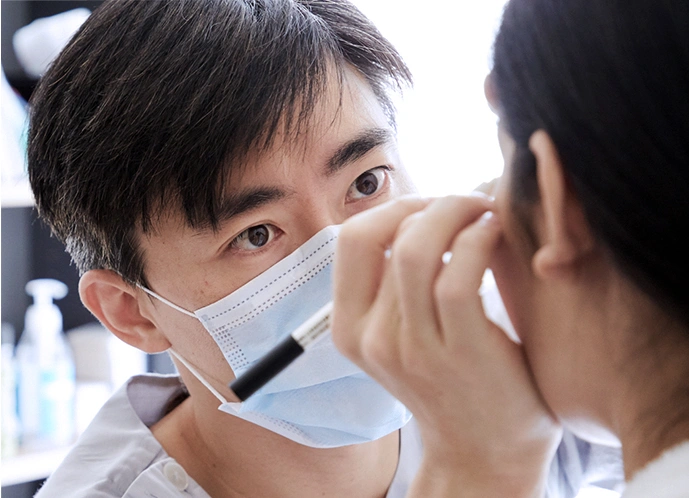
The Safety Checklist
- Board-Certified Plastic Surgeons: Ensure your doctor is a specialist in plastic surgery, not a general practitioner.
- Anesthesiology Specialists On-Site: At View Plastic Surgery, we maintain a dedicated anesthesia department that monitors patients from induction to recovery.
- Emergency Power Systems: Does the clinic have UPS (Uninterruptible Power Supply) to handle power outages during surgery?
- CCTV in Operating Rooms: Transparency is key. We adhere to strict ethical standards regarding surgical operations.
Read about our uncompromising standards at our Safe Surgery System page.
Travel Guide for International Patients: Consultation to Departure
Traveling for surgery requires meticulous planning. Here is a typical itinerary for a primary rhinoplasty patient.
| Day | Activity | Details |
|---|---|---|
| D-1 or D-0 | Arrival & Consultation | Arrive in Seoul. Visit View Plastic Surgery for CT scans, blood work, and final design consultation. |
| Surgery Day | The Procedure | Fasting required. Surgery takes 2-3 hours. Recovery in the clinic ward (short observation). |
| D+1 to D+2 | Rest & Deswelling | Cotton packing removal (usually D+1 or D+2). Swelling peaks. Use ice packs. |
| D+7 | Stitch & Splint Removal | External stitches and nasal splint are removed. You can now see the preliminary shape. |
| D+8 onwards | Return Home | Safe to fly. Swelling continues to subside over the next 6 months. |
For personalized itinerary planning, contact our international team directly via WhatsApp.
Recovery Time and Aftercare: When Can You Fly Back Home?
Recovery is the final stage of the surgical journey. While the immediate downtime is short, the healing process is gradual.
Immediate Post-Op (Days 1-7)
You will have a splint on your nose to protect the new structure. Breathing may be uncomfortable due to internal swelling or packing. Sleeping with your head elevated is crucial to minimize edema.
Deswelling Treatment
View Plastic Surgery offers dedicated deswelling treatments, including Heallite (LED therapy) and lymphatic drainage massage, to accelerate your recovery before you return home. Visit our Aftercare Center for more details.
Long-Term Healing (1-6 Months)
While you can return to work and social activities after stitch removal (Day 7), the “final” result takes time. The tip of the nose is often the last area to soften. Avoid wearing heavy glasses or engaging in contact sports for at least one month.
FAQ
Embarking on a journey for primary rhinoplasty in Seoul is an exciting step toward self-confidence. With world-class surgeons, advanced safety systems, and comprehensive care, View Plastic Surgery is ready to be your partner in this transformation.